
Earth can be as dead as it can be alive
Alymamah Rashed, FIKAR, Hunna Art & Mathqaf
Residency and exhibition
2023
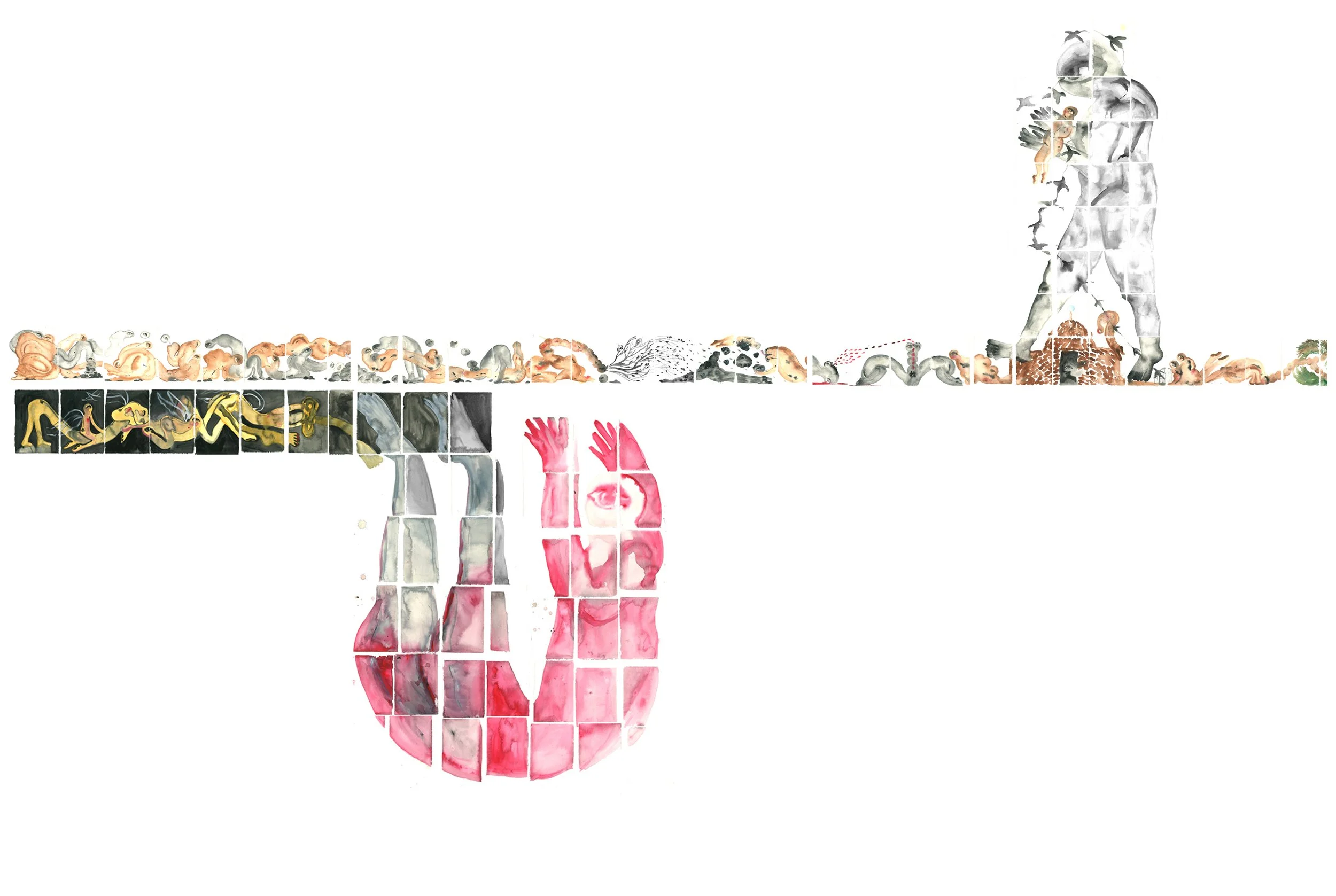
Earth can be as dead as it can be alive:
I collect a fighting conch, a Venus sunray, an eastern Murex, and a sprial whorl.
I collect a lost pottery fragment from the bronze age with three stripes on it.
I collect beach rocks near Al-Khudr’s lost altar.
My spirit hides, my body curves, and my eyes behold the history of Failaka.
— Alymamah Rashed


“Earth can be as dead as it can be alive” is an ambitious research and artistic project that encompasses four strands –an artist residency, an exhibition, an exhibition catalogue, and a public programme– revolving around the relationship between artist Alymamah Rashed and Failaka Island. This project brings together three regional independent, non-governmental, art structures -Hunna Art Gallery; FIKAR: Failaka Institute for Knowledge and Arts Research, and Mathqaf- to promote cross-disciplinary art and knowledge production.
Failaka is an island marked by histories starting from the Bronze Age, across the Greek Hellenistic era, all the way to the 1990 Gulf War. Since then, it has been emptied of its inhabitants and left in a post-apocalyptic state, moved from time to time by international archaeological missions that continue to explore its buried histories, in the looming shadow of State mega-projects which, to date, have not been implemented.
Nowadays, Failaka is an almost forgotten island; a site that many among the younger generation have never visited and, for many among the older generation, a nostalgic memory. Yet, this ancient cradle of global cultures is still brimming with civilizational sites, indigenous flora, manifold mythologies, along with abandoned houses and buildings that testify of its former glorious past. It is there that Kuwaiti Theatremaker Sulayman Al-Bassam has created FIKAR, an artistic and intellectual hub which aims to develop the knowledge economy between Kuwait and the world and to shed light on the Island, with the aim to contribute to its preservation, by establishing a residency dedicated to artists and researchers engaged in projects focused on Failaka.
It is at FIKAR that visual artist and storyteller Alymamah Rashed embarked upon an artistic residency over six months (March-September 2023). Through works that explore her relationship to her own body and spirituality, Alymamah Rashed is today one of the most renowned artists of her generation in the region. Engaged in the development of Kuwait’s cultural ecosystem, she has worked since 2021 at the National Museum of Kuwait allowing her to study at first-hand ancient artefacts from Failaka and to deepen her knowledge about its history.
During her residency, Alymamah Rashed is collecting found objects from the island–for example seashells, terrazzo, pottery fragments, and beach rocks–that, in turn, become figures for a process of drawing studies, expansion and shrinkage. This initial research is further developed by the artist’s exploration of the themes of rituals and fertility which form the substrate of the new body of work developed for “Earth can be as dead as it can be alive”. The results of this research and practice will be exhibited in November 2023 at FIKAR.


Partners
This project brings together three regional independent, non-governmental, art structures -Hunna Art Gallery; FIKAR: Failaka Institute for Knowledge and Arts Research, and Mathqaf- to promote cross-disciplinary art and knowledge production.
-
The Failaka Institute for Knowledge and Arts Research (FIKAR) is a site of knowledge-production and creation dedicated to artists, writers, film, theatre and music practitioners and academic researchers whose work contributes to the celebration, protection and recognition of the ancient island of Failaka
-
Founded in 2021 by Océane Sailly, Hunna Art is an independent contemporary art gallery championing a new generation of women artists based in or from the Arabian Peninsula. Tackling questions of power, of gender, of the history of the Arabian Peninsula, of social relations and of youth culture, Hunna Art’s artists are developing cutting edge visual languages and researches that explore through art historical, social and political narratives as well as dominant representations and subjectivities and personal experiences. -
Founded in 2020 by Wadha Al-Aqeedi and Elina Sairanen, Mathqaf (مَثقَف) is a space and source for art and culture from West Asia and North Africa (WANA). As a research-based platform and a curatorial collective, we publish, curate, collaborate, and champion art through documentation of artists’ lives and institutional histories, articles, and interviews with curators, collectors, and institutions hailing from all over the region and its diasporas.